Your Financial Content Is Technically Correct and Completely Useless
Most financial services content passes every compliance review and still fails the reader. It's accurate, it's broadly applicable, and almost nobody reads it, because compliant and useful are not the same thing.
51% of consumers say they use AI for financial advice and information, according to JD Power. And another 27% are considering it.
Most of them have a bank, and many of them trust it. But they're still typing their financial questions into ChatGPT.
Credit Karma data shows that 77% of Gen Z and 61% of millennials actively seek financial information online, mostly from somewhere other than their banks.
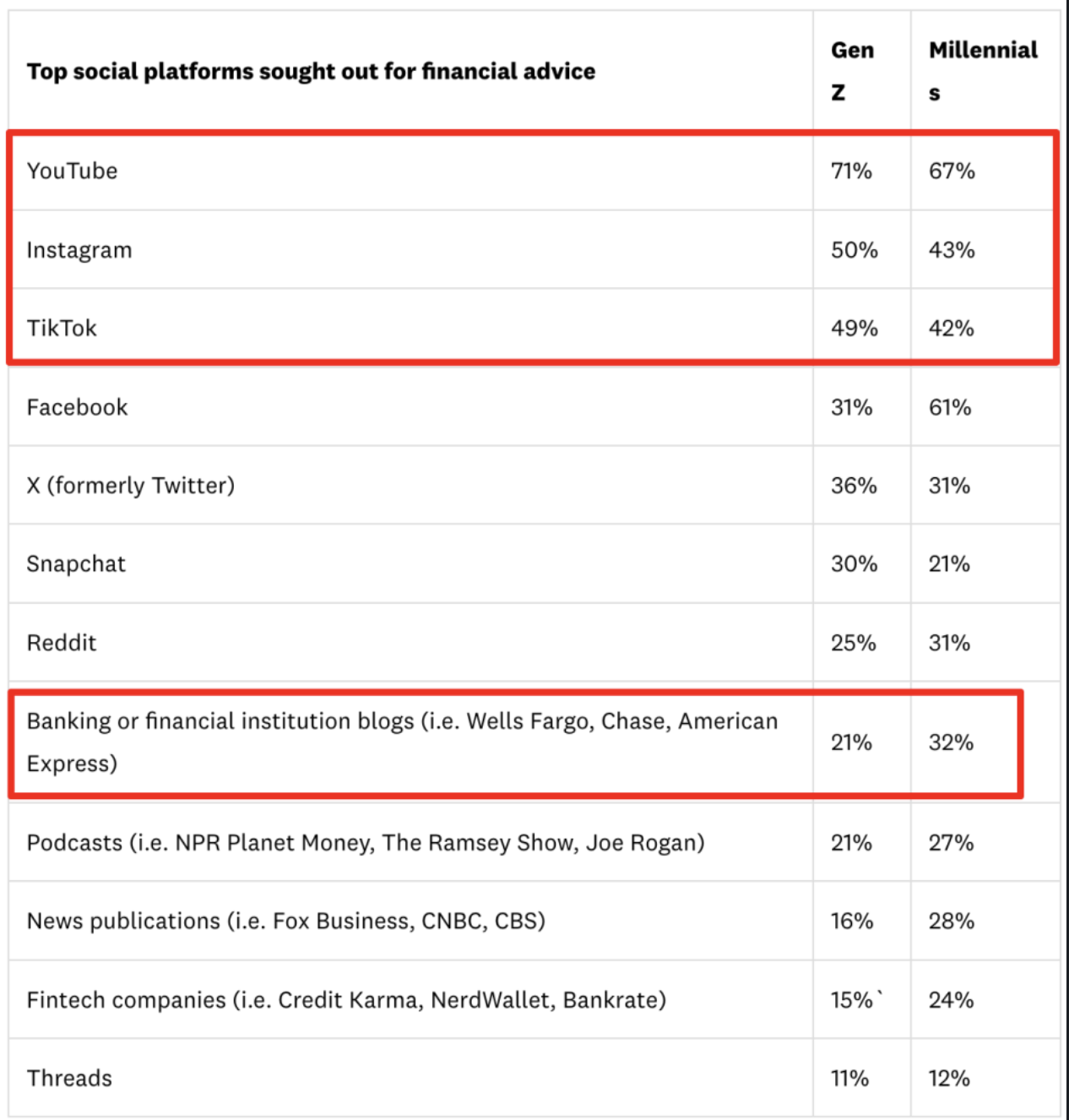
71% of Gen Z go to YouTube for financial advice, while only 21% go to their bank's website for the same questions.
When your financial institution is hovering somewhere around Joe Rogan levels for financial advice, you've got a major problem.
People go where they get a useful answer
Gen Z ranks banks as one of their most trusted sources for money advice, just behind their own parents. And they're skeptical of the places they actually go. According to GoBankingRates, 53% of Gen Z say TikTok is the least trustworthy source for financial advice.
These people trust their bank. And then they go to TikTok anyway.
A correct answer and a useful answer are two different things
People will trade trust for usefulness. A bank's content tends to answer the generic version of a question. AI answers a specific one.
When someone asks how much life insurance they need, they could go to an insurance carrier's blog and get an overview of the types of policies that could work for them, with lots of added caveats.
With ChatGPT, it's a lot more straightforward. It asks about their income, kids, and mortgage, then gives them a number that feels tailored, even if the logic may be shaky.
A chatbot can be confidently wrong, even when they have good data. And a good financial advisor would catch what it misses right away. But answers from chat feel like it's built for one person, and that feeling is what keeps people coming back.
Buried at the bottom of the Credit Karma report is a quote from Courtney Alev, consumer financial advocate:
"It’s also important to remember how personal 'personal finance' is. No two people have the exact same financial profile or situation, so seeking out generic, one-size-fits-all financial advice online often isn’t going to be all that useful, generally speaking. In fact, almost half (45%) of respondents from our study admit that online financial advice is typically too generic or doesn’t apply to their unique financial situations."
Generic advice is extremely easy to churn out. Unfortunately, it isn't as useful to the audience as we want it to be. They want you to go deeper.
The Usefulness Gap
I call this the Utility-Usefulness Gap. It's the distance between content that checks the compliance boxes and content that actually helps someone make a decision. Most financial brands don't know how wide their gap is.
I've spent over a decade writing this content for financial services brands. A lot of the time, the content is generic before anyone writes a word.
I've seen it plenty. A bank hires an SEO firm, and they pick a topic every other bank has already covered because that's where the search volume is. The job becomes beating the top five results for that keyword.
So the writer gets a brief to produce one more version of an article that already lives on 50 other banks' websites.
And while I'd guess almost all of them are accurate and well-sourced, most of them still won't move the needle over the other 49.
That was a great approach in 2021, but in 2026, it doesn't work the way it used to. Brands have to think differently.
Why read 10 blogs that all say the same thing when I can get (what I think is) a personalized response from chat in 45 seconds?
Financial services is a heavily regulated industry. Compliance is real and serious; there are big consequences if you don't comply. It can't be ignored, and it has genuine guardrails that your favorite TikToker doesn't.
That puts brands in this industry at a disadvantage, but it can't become the reason teams stop trying to be useful.
Risk avoidance is not an excuse for boring content.
Useful and compliant can both be true
LLMs have turned the old way of search on its head. Writing for keywords and compliance in a world where your customers are getting guidance from ChatGPT isn't a long-term strategy.
I think there's more room within the guardrails than most brands use. The winners will fill it with something genuinely useful.
That means behaving more like a modern-day digital newsroom. You can do more without ever crossing into advice:
Put real experts on the page (under their own names); consumers may trust specific experts more than a logo
Share original data and frameworks that catch consumers' and LLMs' attention
Don't use compliance as a shield against genuinely helpful and useful content
Experiment with different content styles; not everything has to be a 1200 to 1500 word article
Expand who you're serving and go deeper; try answering the messy, specific questions people actually ask
Banks have the asset that TikTok and ChatGPT are missing, which is trust. Closing the Usefulness Gap is how banks can keep it.
Originally published in The Usefulness Gap on LinkedIn. Subscribe here.
