The Dead Internet Theory (DIT) is the idea that bots have taken over the internet. Bots write stuff, read stuff, and comment on stuff. Corporations send bots out to do their dirty work in the comments, and influencers have their bot army propping up their favorite products.
If you spend any time on any social media, you'll see the bots having a blast in your comments section, just repeating some version of "I agree with your insights on [insert topic here]."
It's driving everyone insane.
What the data says
A recent study called The Impact of AI-Generated Text on the Internet found that as of May 2025, 17.6% of websites are now fully AI-generated. Up from, I bet you can guess, 0% in the pre ChatGPT era of late 2022.
And right now, in the US, Cloudflare says about 70% of HTTP requests distribution to HTML content is by bots vs 30% for humans.
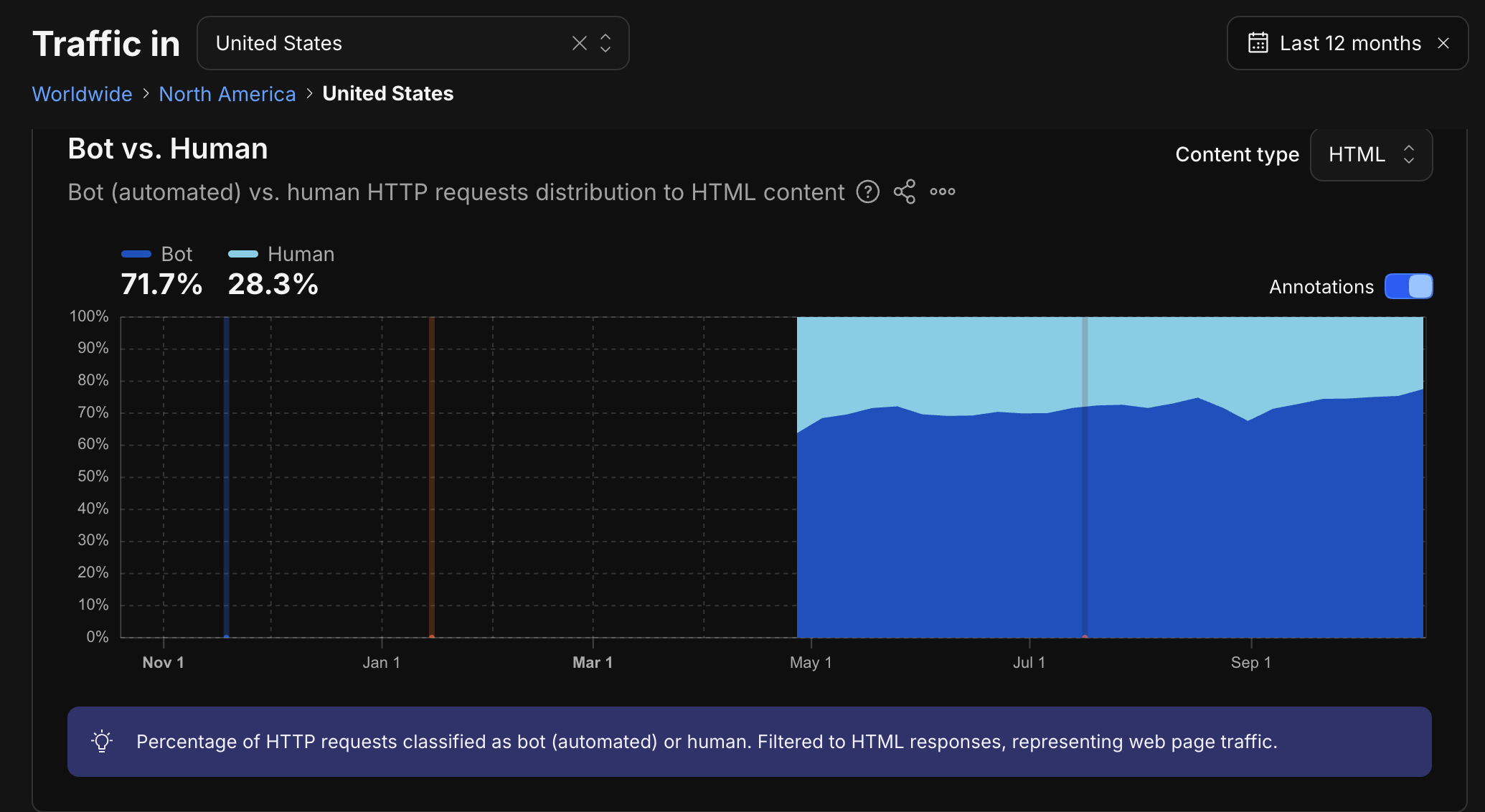
From https://radar.cloudflare.com/traffic/us?dateRange=52w#bot-vs-human
As part of the AI-Generated Text Impact study, the researchers tested six hypotheses to see how the general public feels about AI's impact on the internet. Two of them stand out to me, and both were the only two found to be confirmed in their testing.
"As AI text becomes more common on the internet, the range of unique ideas and diverse viewpoints shrinks."
"As AI content becomes more common on the internet, online writing feels increasingly sanitized and artificially cheerful."
The rest came back negative. They found AI content wasn't more inaccurate, didn't flatten individual voice styles, and wasn't bloated content. For the most part, AI does that fine now.
The only two things that broke are the things that matter: a viewpoint that isn't the consensus, and the willingness to say something that isn't cheerful.
Bots are boring. People aren't.
That doesn't mean that everything that passed is solved. But we can all admit AI is getting better at imitating a voice and sounding like a human.
Where it struggles is having something to say that nobody else is saying. That only comes from a person who knows something.
Claude or ChatGPT can churn out a mediocre to respectable article on a generic topic like how credit unions run credit card programs, for example. But is that article helpful or useful to the readers? Does reading another generic credit card article make a shopper say, " That's it, this is the vendor for me"?
Probably not.
So what's left that the machines can't do?
Be a person with strongly held thoughts and experiences. And that's where SMEs matter.
A VP running a card program for 8 years has more insights and anecdotes on credit cards at community banks and credit unions than a bot can ever scrape. Every company has a pretty untapped well of all the stuff AI can't do: have a unique viewpoint and be ruthlessly negative about your industry.
Haha just kidding. (Mostly).
A case for tapping the well
I've spent a lot of time chatting with SMEs over the years. And many of them are literally chomping at the bit to share everything they know about a topic with you.
Just the other day, I was writing an article on financial planning for a bank. They wanted to send over some SME insights to help, so I said sure. I got 3,000 words.
But in those words were a lot of gems and insights that only this expert would know because they are deeply embedded in this particular type of financial planning. They had real-life experience and could use that in sharing strong opinions and giving realistic outlooks on the situation. So I curated everything they said into my research and got it to a tight 900 words.
All of that mattered. My article had way more juice because of that info. It wasn't just another generic piece of human slop that wasn't going to move the needle.
So that's where you can fight back. Not by churning out more or publishing faster. Find the people with something to say who are often overlooked. The person down the hall running things for a decade knows the stuff no model can scrape and come up with on their own.
It usually doesn't take more than 15-30 minutes to get really good information and an expert opinion that stands out in a sea of the same old boring consensus idea. Be the brand that's interesting and putting out unique thoughts in your niche.
Originally published in The Usefulness Gap on LinkedIn. Subscribe here.
